
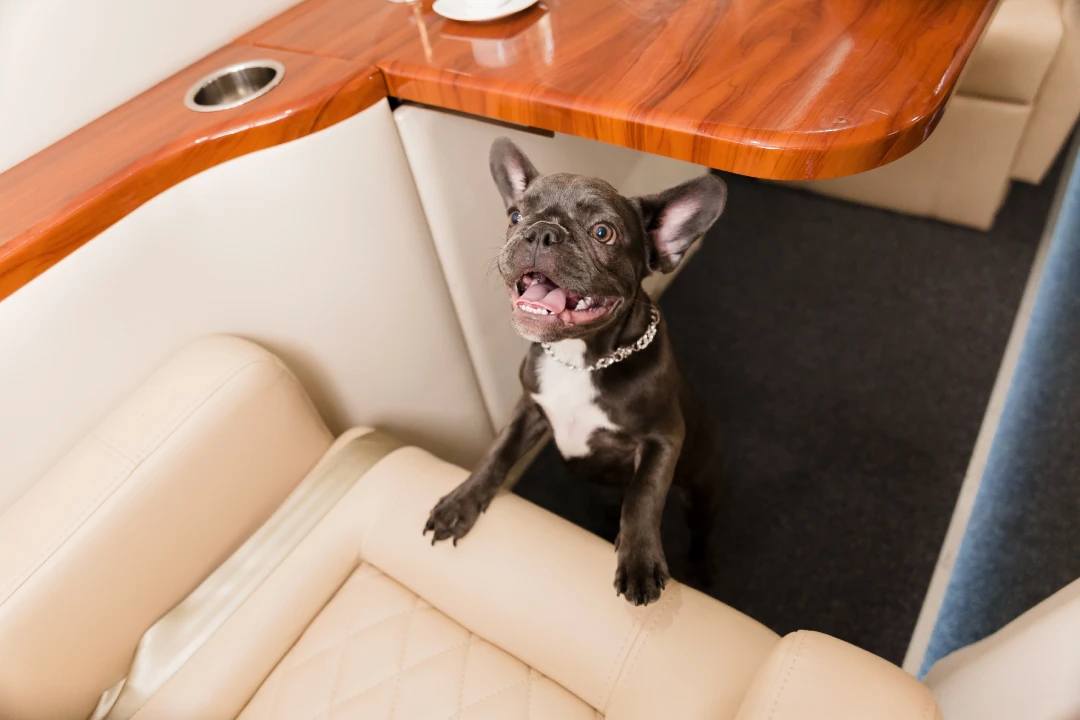
What It Really Takes to Travel Together
Flying with animals has always captured the imagination. It’s dramatic. It’s headline-worthy. It’s occasionally scandalous…
But for the people who actually want to fly with their dog, cat or any animal — whether relocating, splitting time between countries, or simply refusing to treat a family member like freight — it’s not dramatic at all.
It’s layered. It’s personal. And in Australia, it’s taken very seriously.
So, are pets allowed on private jets?
Absolutely.
The better question is which aircraft, and who’s managing it.

At AVMIN, we don’t just secure an aircraft and hope for the best. We look at the route, the duration, the size and temperament of the pet, and the operator policies before we ever send a proposal.
Not all aircraft are created equal. Smaller jets can be noisier and more sensitive to weather. Larger jet categories are pressurised, quieter and offer smoother long-haul flight profiles. When our clients plan to travel longer distances with their pets, we guide them toward aircraft that make sense — for the people and the paws onboard.
Most operators require pets to be secured in an approved carrier for taxi, take-off and landing. That’s standard. On suitable aircraft, and subject to operator policy, pets may remain close to their owners once cruising. Movement allowances vary, and we clarify that before departure so there are no surprises.
These aren’t dramatic details. They’re the kind of things we think about automatically.
There are also practical considerations handled quietly behind the scenes:
- Ensuring pets toilet before boarding
- Managing food and water intake onboard
- Confirming post-flight cleaning protocols for allergens
When you work with a team that understands both aircraft and animal transport, none of this feels chaotic. That’s the difference between simply booking a flight, and properly planning for family travel.
When “Near Enough” Isn’t Enough
Cast your mind back to 2015… Two very small dogs. One very famous owner. And suddenly, Australia’s quarantine laws were leading international news.
The Pistol and Boo saga wasn’t really about celebrity pets and VIP travel. It was about standards.
Most countries take biosecurity seriously. The UK has strict rabies sequencing. New Zealand is meticulous. Singapore is highly regulated. The United States has layered federal and state requirements.
Australia is no different, as well as having a reputation for not tolerating “near enough.” And that’s why it became a headline moment. When you fly with a dog into or out of Australia (whether on a commercial service or a private jet) the margin for error is slim.

It’s also worth understanding something important: this isn’t about “germs” in the casual sense. It’s about systems designed to protect ecosystems.
A live animal isn’t treated like a piece of luggage because it isn’t one. It can carry parasites, diseases or soil-borne risks. That’s why the animal itself is regulated differently to the human travelling beside it.
When you zoom in, there are many layers:
- Vaccinations aligned precisely to timeframe
- Parasite treatments completed in strict sequence
- Documentation completed exactly as required
- Operator approvals secured before departure
- Refuel stops assessed carefully
- Possible quarantine stays depending on final destination
We recently coordinated a long-haul charter that required a technical refuel stop en route to Australia. The aircraft could land. The passengers could stretch their legs. The dogs remained onboard.
Allowing them to disembark would have triggered quarantine processing in that country, followed by repeat clearance before departure. A small misstep can multiply quickly.
A private jet doesn’t override those rules.
What it does allow is structure (the route, the sequencing, the approvals) to be planned calmly and correctly from the outset. And when that planning is done by our team, what looks complicated on paper feels seamless in the air.

Private Jet vs Commercial
Commercial airlines are evolving, with some domestic routes now permitting small pets in-cabin. However, weight limits, carrier dimensions and fixed schedules still apply. When you fly with a dog commercially, you work within those boundaries.
When you fly privately with an AVMIN charter, the structure is different:
- Scheduling is built around you.
- Aircraft is selected for the journey.
- Pets travel in the cabin with you.
- There is no separation into cargo.
For many families, this isn’t about status. It’s about reducing variables. Importantly, the charter cost of the aircraft does not increase simply because a pet is onboard. The aircraft is chartered as a whole. The value lies in flexibility, suitability and peace of mind — not novelty.
Experience Makes the Difference
Our team recently coordinated a long-haul charter from the United States to Australia for two cute pups travelling with their owners. The crew practically volunteered for this one.
The dogs had their own menus. Their own blankets. Treats. Goodie bags. They were pampered the entire way home!
That calm arrival into Australia was the result of detailed coordination:
- Operator approvals secured well in advance
- Documentation aligned precisely with biosecurity requirements
- Aircraft selected for long-haul suitability
- Border compliance planned before departure
- Arrival sequencing mapped so nothing was left to chance

We act as the bridge between client and operator — the ones asking the extra questions, confirming the small details, thinking three steps ahead. When you fly with a dog internationally, especially into Australia, the difference is sequencing.
The aircraft matters. The approvals matter. The timing matters.
Flying with animals shouldn’t feel chaotic or controversial. It should feel like travelling with your best mate. Before you book,
talk to the team that understands aircraft, operators and biosecurity from experience.